Yesterday, we left Asheville, North Carolina, and today we’re in New York’s Hudson Valley. As we continue our journey, I am still thinking about the people we met in Asheville and the stories they shared.
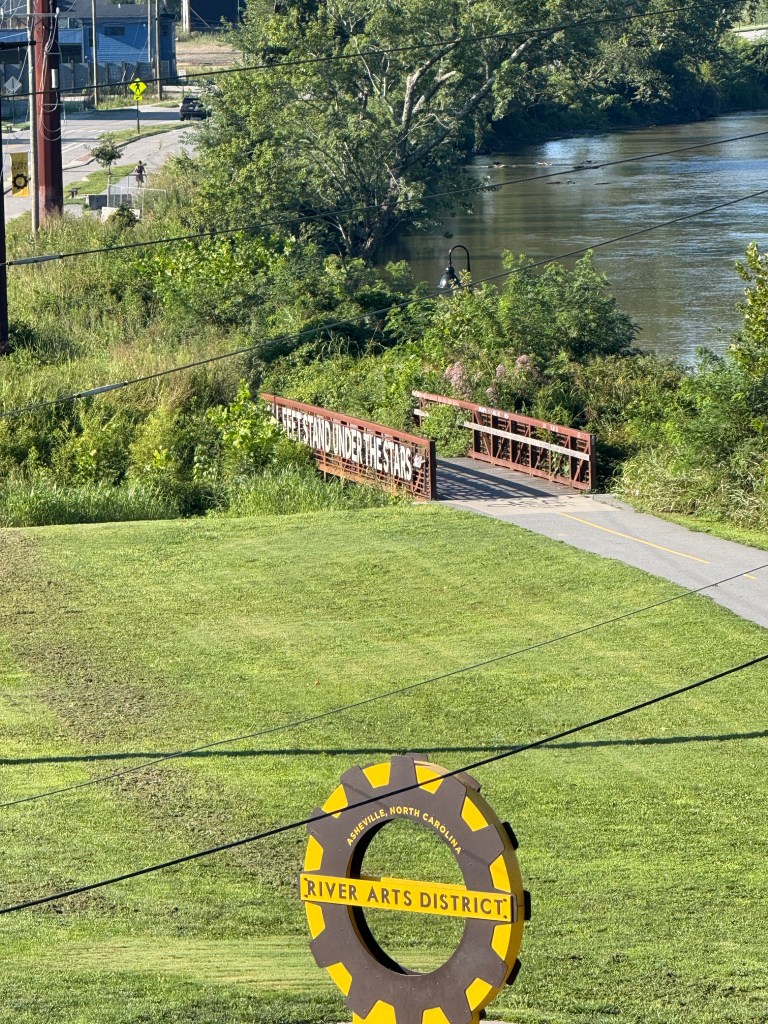
We spent our time walking around the River Arts District and Biltmore Village. In the Arts District, I bought a painting of a bear. Black bears are a big part of Asheville, just as they were in Gatlinburg. One of the artists told me about the different bear paintings, and together we chose the one that seemed to be saying, “It wasn’t me. I didn’t do it.”
The artists are Kelcey Loomer, Elizabeth Porritt Carrington, and Amanda McLenon; two of the three were there when we visited. They asked what had brought us to Asheville, and when we told them, they shared part of their Hurricane Helene story. They also showed us a piece of art created in response to the disaster.
I wanted the painting, but it was far too big to fit in the truck. As a reflection of the disaster and the real lives it affected, the piece spoke to me.
Our conversation also reaffirmed my belief that we should not edit the videos unless the storyteller specifically asks us to do so. The artists told us that some people had edited interviews in ways that changed the meaning of what was being shared. Their words reminded me how important it is to honor people’s stories and let them speak for themselves.
One of the artists shared links to two stories related to the hurricane. Both are powerful:
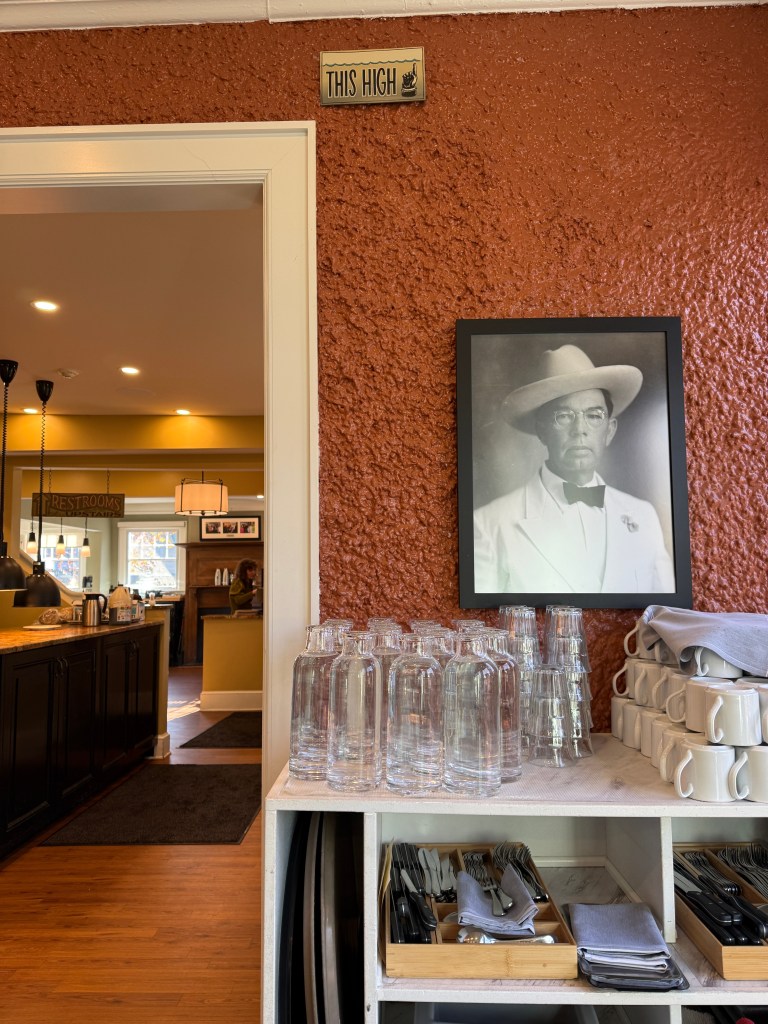
Each morning, we had breakfast at a restaurant where a sign on the wall read “This High,” showing the water level. It reminded us of what the community had experienced. The restaurant also served the best huevos rancheros I have ever had—and I live in New Mexico.
We walked the land, and we listened to the people. I left thinking that I can never fully understand their trauma or their strength. What I did understand was the importance of true friends and communities during times of disaster.
Our time in Asheville also had me reflecting on what it means to have good friends. A good friend connected me with one of the people we interviewed. When I asked him how he knew her, he told me their story and how helpful she had always been to him. He was happy to do the interview for her.
Listening to him, I thought about how helpful she has been to me since I first met her. Sometimes life puts amazing people in our path, and those people are a true blessing.
As we left Asheville, admiring the beauty of the communities and the mountains, I knew I would be back. The mountains will call me back.
We spent the weekend in Gatlinburg and the Great Smoky Mountains, where the last of the fall leaves met the first snow of the year. Leaves covered the ground, and others still clung to the trees. It was a good weekend to pay attention to what is passing, what remains, and how we live with both.
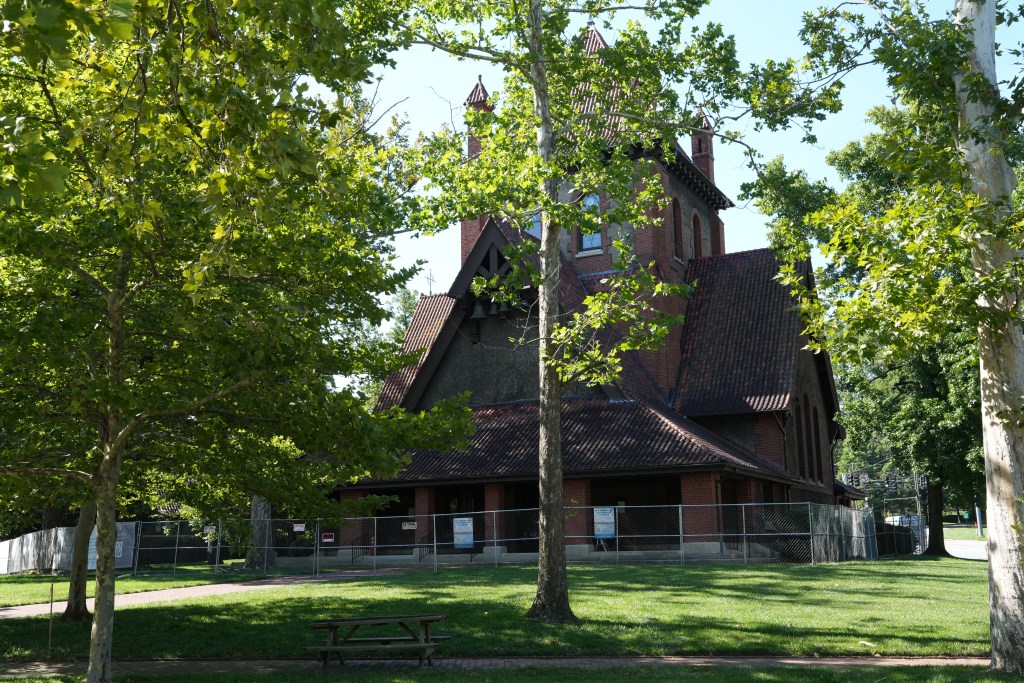
We were there, in part, to listen. Ten years ago, wildfire swept through these mountains and the surrounding communities. Fourteen people died. Homes, businesses, and church buildings were damaged or destroyed. During our visit, we sat down with Pastor Kim at Roaring Fork Baptist Church to hear his reflections on the fire and the work of rebuilding.
Listening to him also brought back a part of my own life: attending a Baptist church as a teenager. I went largely because my high school friends went there. Whatever else brought people through those doors, friendship was a large part of what brought me.
There is something worth remembering about that. We do not always enter a spiritual community because we have settled our beliefs or worked out our questions. Sometimes we go because someone we care about will be there. We find our way into a place through the people who make room for us.
Sitting with Pastor Kim, I found myself remembering those years while listening from where I am now. My spiritual practice has taken a different path, but the conversation felt familiar in ways I had not expected. It reminded me how much spiritual life happens through ordinary relationships: gathering, listening, sharing grief, and helping one another do what needs to be done.
After a disaster, those relationships matter. Rebuilding requires materials, money, labor, and countless practical decisions. It also asks people to keep living with losses that construction cannot repair. A new building does not bring back someone who died. Beginning again does not mean that what happened has been put behind us.
This morning, those mountains and that conversation were with me as I offered a dharma talk on the Heart Sutra.
Form is emptiness; emptiness is form.
Emptiness can sound like an absence, but in this teaching, it means that nothing exists independently. A leaf is empty of a separate existence because it depends on sunlight, rain, soil, air, and time. Look closely enough at the leaf, and all those conditions are there.
Thich Nhat Hanh called this interbeing. Nothing simply exists on its own.
The leaves in the Smokies made this teaching easy to see. They had shaded the forest, changed color, and fallen. Now they covered the ground. In time, they will become part of the soil from which other life grows. Here in Asheville, where I am now, the last leaves still cling to the trees. The same season is unfolding a little differently from place to place.
I thought, too, about Dōgen’s teaching on firewood and ash. Ash does not become firewood again. There is no returning to the world exactly as it was before the fire.
That matters when we listen to a community that has lived through disaster. It asks us to resist making loss into a reassuring story too quickly. There can be rebuilding and grief, generosity and exhaustion, gratitude and things that remain unresolved. We can make room for all of it.
For me, this is part of why spirituality matters in life. It offers a practice for staying present when we cannot fix everything. It asks us to consider what we depend on, what we owe one another, and how to care for the life in front of us. Our conversation with Pastor Kim reminded me that we can approach those questions through different traditions and still have much to hear from one another.
Of course, the weekend also included a bear.
The bear found my truck interesting enough to open the back and bend the back door. It drank all my sparkling water except one. The remaining one was covered in bear drool, which settled the question of whether I wanted it.
I did not.
There is the contemplative account of a weekend in the mountains, and then there is the account that includes a bent truck door and a bear with an apparent enthusiasm for sparkling water. Both belong to the trip.
The bear was also a rather forceful reminder that the mountains are not simply scenery for our travels. Other lives are being lived there, with purposes entirely their own. I would have preferred that this particular life leave my truck alone.
I am carrying all of it with me: the leaves, the snow, the damaged door, and the conversation at Roaring Fork Baptist Church. I am carrying memories of the teenager who went to church because her friends were there, and questions about the communities we turn to when life becomes difficult.
In bearing witness to a wounded land, I want to listen to the people who call it home, including the spiritual communities that help them make sense of loss and continue caring for one another. Listening does not require that we share every belief. It requires that we be willing to be present.
The question I offered at the end of this morning’s talk stays with me: What is one thing you think of as around you that is really part of you?
The trails of the Route 66 State Park, where the homes of Times Beach once stood.EPA Testing in Times Beach
Yesterday I sat with a woman who spent part of her childhood in Times Beach, Missouri. As with every conversation in this series, she’ll tell her story in her own words when the video goes up. I won’t try to retell or interpret it here.
But I’ve now walked the ground where her town used to be, and I keep thinking about the place itself. So here is a little of what I’ve learned about Times Beach: where it came from, what happened to it, and what stands there now.
A town sold with the newspaper
Times Beach began as a promotion. In 1925 the St. Louis Star-Times bought a wedge of land along the Meramec River, about 17 miles from downtown St. Louis, and carved it into thousands of small lots, each 20 by 100 feet. To boost subscriptions, the paper sold a lot with a subscription for $67.50, with $10 down and small monthly payments (Alexander, 2026; Leistner, n.d.). It was pitched as a place for city families to have a summer cottage by the river.
The river was the draw, and the risk, from the start. Many of the earliest cabins were built up on stilts because the Meramec flooded (Leistner, n.d.).
A year later, Route 66 came through Missouri, and by the early 1930s a new steel truss bridge carried the highway across the Meramec right at the edge of town. The Bridgehead Inn opened beside it in 1935, and from 1947 to 1972 it ran as Steiny’s Inn, a well-known stop for travelers on the Mother Road (Alexander, 2026).
From resort to hometown
The weekend-cottage dream didn’t last. During the Great Depression, many owners moved into their little river cabins full time because they couldn’t afford anything else. After the war, a housing shortage in St. Louis and better commuting roads brought more year-round residents. Times Beach became a working-class town of more than 2,000 people, still with a riverfront for swimming, picnics, and boating (Alexander, 2026; Leistner, n.d.).
When Interstate 44 was built in the late 1960s, highway traffic moved off the old bridge, and Times Beach became quieter, with people driving past rather than through (Alexander, 2026).
Dust on the roads
In the early 1970s, the town had more than 16 miles of dirt roads and no money to pave them, and dust was a constant complaint. The town paid a local waste-oil hauler, Russell Bliss, to spray the roads with oil to keep the dust down, starting in the summer of 1972. The town’s last mayor remembered the spraying in the summers of 1972 and 1973, while other accounts say it continued until 1976 (Alexander, 2026; Leistner, n.d.).
No one in town knew that some of that oil had been mixed with waste from a chemical plant in Verona, southwest Missouri, that made ingredients for the defoliant Agent Orange and the antibacterial hexachlorophene. That waste contained dioxin, one of the most toxic compounds known, linked to cancer and to reproductive, developmental, and immune problems (Little, 2020).
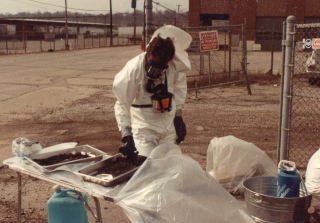
The same mixture had been sprayed at more than two dozen sites around the state, including horse arenas, where dozens of horses died and a child fell seriously ill in the early 1970s. Health investigators eventually traced those illnesses back to dioxin, and by 1982 the EPA was sampling the soil in Times Beach (Little, 2020; Stehr et al., 1986).
The flood
On November 10, 1982, a newspaper reporter called city hall to say Times Beach might be one of the places Bliss had sprayed. Less than a month later, on December 5, the Meramec crested at nearly 43 feet, more than 24 feet above flood stage, in the worst flood in the town’s history. On December 23, residents were told that anyone in town should leave and anyone away should not come back, a warning they came to call their “Christmas message” (Leistner, n.d.). Residents feared the floodwater had spread dioxin from the roads into yards and homes, and health officials recommended that no one move back (Little, 2020).
In February 1983, the EPA announced that the federal government would buy out the entire town, roughly 800 homes and 30 businesses, at a cost of about $32 million (Alexander, 2026; Little, 2020). Testing found dioxin at levels hundreds of times the CDC’s safe level (Little, 2020). It was the country’s first buyout of its kind, paid for through the brand-new Superfund program. By 1985, nearly everyone had left, and the state formally disincorporated the town (Alexander, 2026).
Leaving was not the end of it. Marilyn Leistner, the town’s last mayor, later described low buyout offers, families stuck paying mortgages on homes they could no longer live in, and children at new schools being kept away from Times Beach kids out of fear they carried the contamination (Leistner, n.d.).
The full health effects of exposure are still not known. An early pilot study led by the CDC examined 104 people from contaminated sites around Missouri, 68 at high risk of exposure and 36 at low risk. It found no firm evidence of increased disease and no cases of chloracne, the skin condition most linked to dioxin, but the authors cautioned that the study was too small to rule out long-term effects such as cancer and called for more research (Stehr et al., 1986).
Erasing a town
For more than a decade the town sat empty behind barricades. In 1996 a temporary incinerator was built on the site, and over the next year or so it burned roughly 265,000 tons of contaminated soil and debris, not just from Times Beach but from dozens of dioxin sites across eastern Missouri. It destroyed houses, businesses, and even the water tower. What remained was buried in a mound on the property. The cleanup was declared complete in 1997, and in 2001 the EPA removed Times Beach from its list of the nation’s most hazardous sites. Follow-up soil testing in 2012 found no significant risk to park workers or visitors (Little, 2020).
What’s there now
In 1999, Missouri opened Route 66 State Park on the land where Times Beach once stood. Today it’s an easy, green, quiet place: miles of trails for walking, biking, and riding, a boat ramp onto the Meramec, picnic areas, deer and turkeys, and plenty of birds. It’s off I-44 at exit 266 (Alexander, 2026).
If you know what to look for, though, the town is still there. The visitor center is the old Bridgehead Inn, Steiny’s Inn, the only building from Times Beach left standing, and it holds exhibits on Route 66, the town, and the cleanup. The old 1930s bridge still crosses the river, though it has been closed to traffic since 2009 (Alexander, 2026). And there is the mound, where the homes and belongings of the people who lived here are buried (Little, 2020).
When I was there, the Park Ranger showed me an exhibit of what Times Beach had been. After seeing it, I could walk the area and see where some things used to be, but for the most part it was a beautiful park with nice walking paths. There were people walking dogs and running. There was a boat ramp and the frame of the old Route 66 bridge, but the dirt roads were gone, the were no homes, no businesses, not church and nothing that indicated it had been a community where families lived and children played.
Why it matters
Times Beach is often described as one of the worst environmental disasters in American history (Little, 2020), and it helped shape how the country deals with toxic waste. But a town is more than a case study. Families planted gardens there, kids rode bikes on those dusty roads, and people built lives around a river they loved. Thousands had to leave it all behind.
That’s the part only they can tell. Watch for the video, coming soon, where one of them shares her story in her own words.
Stehr, P. A., Stein, G., Falk, H., Sampson, E., Smith, S. J., Steinberg, K., Webb, K., Ayres, S., Schramm, W., Donnell, H. D., & Gedney, W. B. (1986). A pilot epidemiologic study of possible health effects associated with 2,3,7,8-tetrachlorodibenzo-p-dioxin contaminations in Missouri. Archives of Environmental Health, 41(1), 16–22.
Fifteen years ago, on May 22, 2011, an EF5 tornado touched down southwest of Joplin, Missouri, and cut a nearly mile-wide path across the southern half of the city in under twenty minutes. It became the costliest tornado in United States history, claiming 161 lives, displacing more than 9,000 residents, and damaging or destroying roughly 7,500 homes alongside hundreds of businesses, schools, and civic anchors.
Today, if you drive through Joplin and want to know where the tornado carved through town, all you have to do is look at the trees.
The storm leveled the mature canopy that had shaded Joplin’s neighborhoods for generations. In the blocks spared by the funnel, century-old hardwoods still tower over streets and rooflines. Along the path of destruction, however, the tree line suddenly drops. The trees standing there now are slender and young, their shade sparse by comparison. Houses can be rebuilt in a year or two, but a canopy takes a lifetime to regrow. Fifteen years later, these young trees silently trace the tornado’s scar across the landscape—yet they also stand as living markers of every neighborhood where residents chose to return, replant, and rebuild.
Young trees trace the path Where the old green shadows fell New shade roots again
The tornado left Joplin facing an enormous task: caring for the injured, helping displaced neighbors, and restoring the places people depended on every day. The response came from across the entire community. Neighbors helped evacuate 183 patients from the darkened, heavily damaged halls of St. John’s Regional Medical Center in about 90 minutes. Around 28 houses of worship across the city were damaged or destroyed, including congregations directly in the path like the 26th and Connecticut Church of Christ. Yet even as members suffered profound personal losses and structural wreckage, churches immediately opened their doors as relief stations. Congregations whose buildings survived became bustling distribution centers for food, water, and clothing, welcoming a surge of volunteers who arrived from across the country to lend a hand.
City leaders had no formal disaster recovery playbook, but they adopted a simple, powerful question to guide every choice: Would it help keep people in Joplin? That resolve showed up everywhere. Temporary housing was organized rapidly, the school district managed to welcome students back on schedule that August, and the local Chamber of Commerce launched a recovery center within days. While the road was uneven and took years of hard work, that collective commitment bore fruit: by 2015, Joplin’s population had actually grown past what it was before the storm.
Disaster research often measures recovery in numbers, aid dollars, and timelines. But Joplin reminds us that behind every statistic is a household, and genuine rebuilding is something neighbors do for one another.
I recently had the privilege of sitting down with former and current leaders of the local Church of Christ community, who generously gave their time to share their memories of enduring the storm and walking alongside their neighbors through the rebuilding years. Their personal experiences reflect compassion, charity, and endurance. Because it is their story to tell, I look forward to sharing an upcoming video conversation where you can hear it directly in their own words.
Until then, if you ever find yourself passing through Joplin, slow down and watch the roadside. In the branches of those young, flourishing trees, you will see both the quiet memory of what was lost and the living endurance of a town that chose to stay and grow again.
In an era shaped by ecological change and the visible marks of the Anthropocene, our inner experience can reflect the changes unfolding in the natural world. Wildfire scars, shifting watersheds, toxic sites, and prolonged drought are not merely distant headlines; they are tangible realities written across the places we inhabit.
Ecological Witness and Land-Based Practice offers a contemplative space to meet these realities directly. These self-directed gatherings bring individual experience into relationship with the land beneath our feet. By sitting quietly, walking attentively, and sharing what we notice, we practice bearing witness to ecological grief while also finding connection, care, and resilience.
Our recent gathering took place at the John Robert Dam in Albuquerque at 7:00 AM on Saturday, August 29. We met in the early morning light and walked a short distance together before settling into a place on the land. Before entering silence, I offered a brief history of the area and the dam’s purpose.
We then sat in silence with the land for thirty minutes. At first, the sound of traffic was present, but after a short while it faded into the background. Other sounds became clearer: birds calling, wind moving through the landscape, and bees at work nearby. Rabbits moved through the brush, and roadrunners crossed the open ground. The desert revealed itself slowly through sound, movement, and stillness.
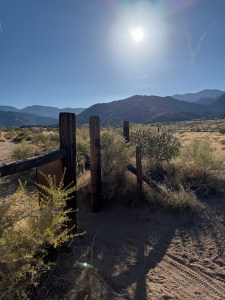
When the sit ended, we gathered to discuss what we had felt, heard, and seen. We also talked about how we might better share and promote this endeavor so that more people can participate in land-based meditation throughout New Mexico. Afterward, we shared tea and began a hike through Bear Canyon to the second fence, a four-mile round trip.
Something changes when we hike together. On a city street, people may pass one another without making eye contact or offering a word. On the trail, the people we meet almost always offer a cheerful hello. There is a shared recognition that we are all moving through the same landscape, breathing the same air, and making our way along the same path. These small exchanges can create a sense of belonging and remind us that connection is still possible.
There is a particular beauty in hiking through the desert. As you breathe up through the ground and back out through the ground, you connect with the place beneath you. The land is not separate from us; it is something we move with, listen to, and depend upon.
These gatherings are an invitation to show up for the land in all its vulnerability and quiet resilience. In doing so, we may also learn how to show up more fully for ourselves, one another, and the communities we call home.